Why the wrapper has a question on it.
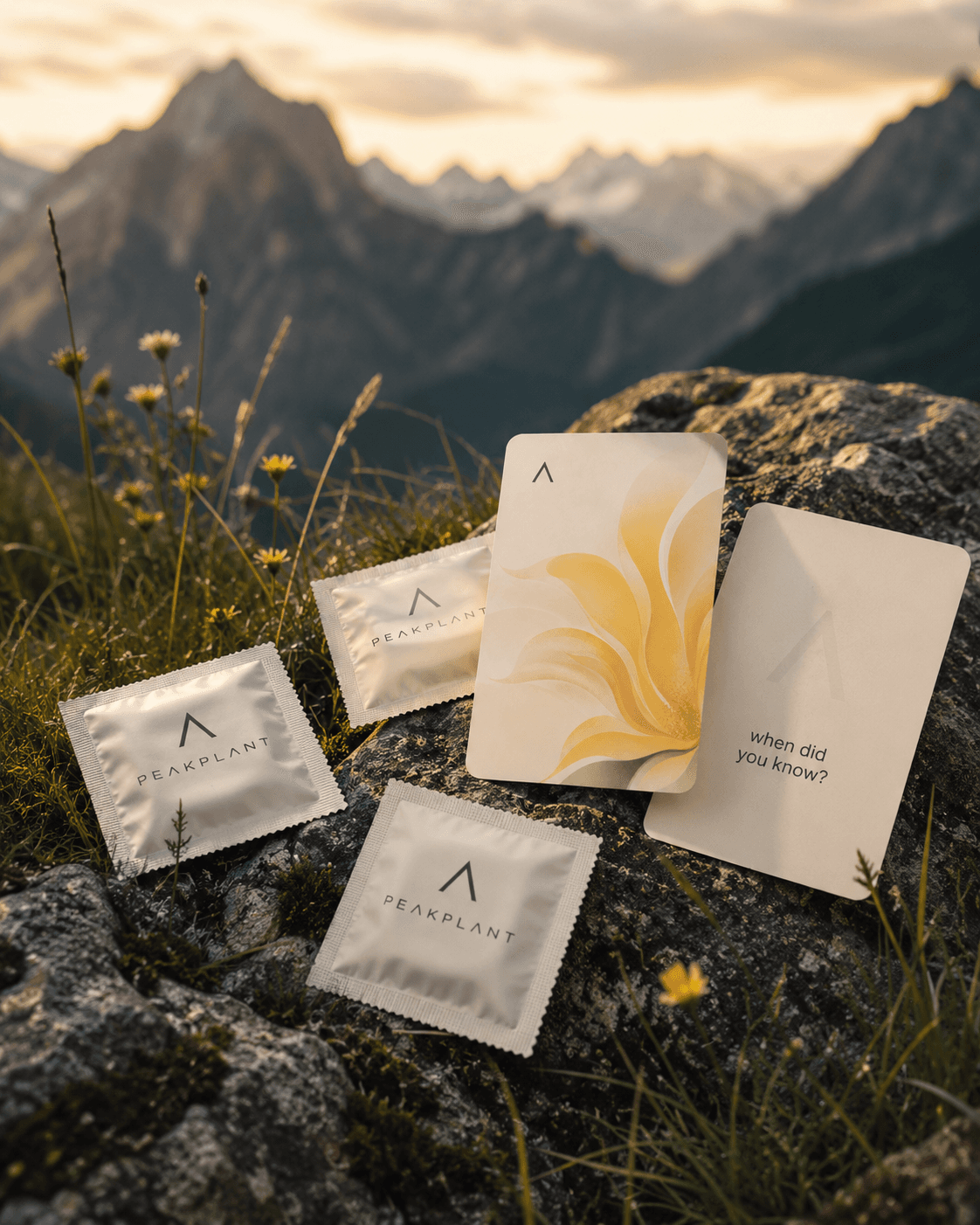
Most condom packaging is designed to disappear. Or to signal confidence. Or to feel clinical and responsible. What almost none of it does is create a moment of pause before one of the most intimate things two people can do together.
When we started designing the first PeakPlant collection, the question was not: how do we make this look better than other brands? The question was: what should this object actually do in the moment someone picks it up?
Because there is a moment. Between reaching for the packaging and opening it, there is a beat — brief, often unexamined — where something could be different. Where instead of rushing through a logistical step, two people could actually arrive in the room with each other.
The wrapper as design philosophy.
We put a question on each wrapper. Not as decoration. Not as a brand flourish. As an invitation to pause. To look at the person you are with. To be, for a moment, present rather than procedural.
Questions like: What do you need right now? Or: When do you feel most yourself? Or: Tell me something you've never said out loud.
These questions do not require answering. They require noticing. The act of reading them together — even briefly, even silently — interrupts the automation. It creates a micro-moment of actual contact, the kind that intimacy is made of but that speed tends to eliminate.
Simon Sinek's work on intentionality in leadership keeps coming back to the same insight: behavior changes when you change the environment that prompts it. We are trying to redesign a small environmental prompt — the wrapper — in a way that points toward presence rather than away from it.
Why packaging is never only packaging.
The object you hold shapes how you feel about what you are about to do. Clinical packaging says: this is a medical precaution. Aggressive packaging says: this is about performance. Packaging with a question says: this is about the two of you.
We chose matte, tactile materials — not for aesthetic reasons alone, but because textures register subconsciously. A surface you can feel properly reminds you that you have a body. That you are here, in this moment, in this room.
The seed in the corner of the box is not an accident either. It is a symbol: something small that holds the possibility of growth. Every PeakPlant box contains one, because what we are really designing for is not a single encounter but a longer arc — the accumulation of moments in which two people choose presence over performance, and slowly build something between them that can grow.
Design is never neutral. Every object says something about what the people who made it believe matters. This is what we believe matters: that the moment before intimacy deserves to be treated as a moment, not a procedure.